
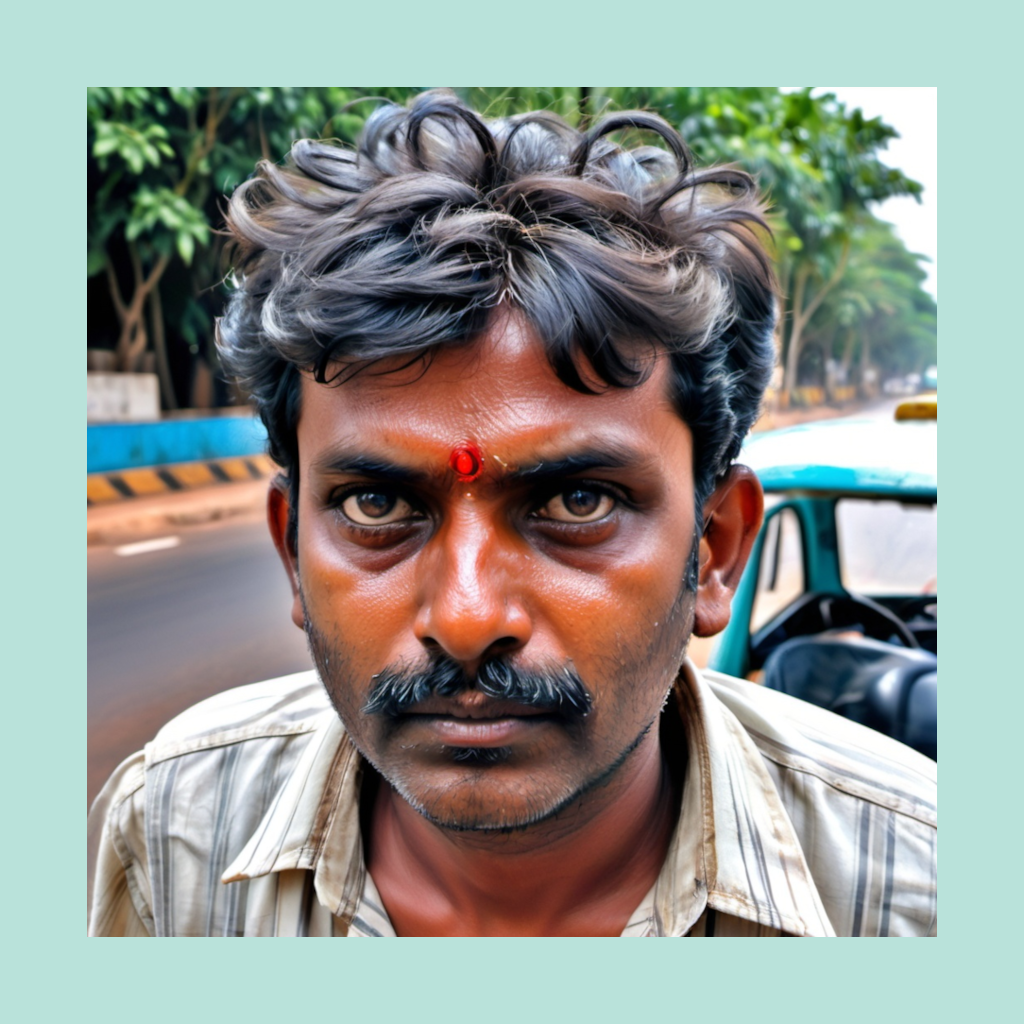


Today, I want to share a personal experience—one involving an auto driver named Sekar and his wife, Philomena. It’s about an incident that deeply affected me, the doubts it raised, and how a shift in perspective ultimately brought me peace.
Before diving into the story, I should mention that last week I tried to generate an AI image of an auto driver for this post. Although the result isn’t exactly what I had in mind, it’s the best I could settle on for now. So, let’s begin.
The Background
I can’t recall the exact date, but this happened between late 2007 and early 2008. Back then, I lived in Thiruvanmiyur and commuted daily to the MIT Campus of Anna University in Chromepet for my PhD research at the AU-KBC Research Centre. My daily routine involved taking an auto( rickshaw) from outside my apartment to Guindy railway station, followed by a suburban train to Chromepet. In total, it was an hour-long journey.

Meeting Sekar
On that particular day, I couldn’t find my usual auto drivers and was running late. A dishevelled man with bloodshot eyes and a two-day stubble pulled up in his auto. Normally, I would have avoided someone like him, but pressed for time, I had no choice. With hesitation, I got in.
Almost immediately, he received a call and began pleading with someone on the phone. This was to continue for the next few minutes. He pulled over with each call, causing further delay, and eventually, I saw him in tears.
Sekar’s Story
Torn between frustration and concern, I asked what was wrong. Sekar, a Hindu, had married Philomena, a Christian, against their families’ wishes, and they were estranged from both sides. His wife, Philomena, was pregnant, hospitalized and needed a C-section. He had been driving overnight to gather enough money for the surgery.
It was a touching story, but as someone new to Chennai, I was wary of scams. I wasn’t sure if I should help or if I was being played.
The Dilemma
Over the next few minutes, I realized that I had some cash on me to pay for my semester fees. Fortunately, it was neither my next meal’s money, nor was it urgent to pay the fees. Still, I wondered if I would regret giving him the cash—what if it was all a lie? What would my family think?
After some internal debate, I decided to give him the money, a few thousand rupees, the exact amount of which I can’t recall today. When we reached Guindy station, I got down and handed him the cash. In a dramatic gesture, he touched my feet in gratitude, and I was so embarrassed by the act in front of the crowd around us that I hurried off without asking for his contact details.
The Lingering Doubt
I thought that was the end of it, but soon after, I was consumed by doubt. The next few days, I searched the newspapers for any mention of Sekar or his wife, hoping for some cinematic resolution, but there was nothing—no heroic rescue, no tragic loss. I wondered if I’d been cheated.
For a long time, I kept the incident to myself. On one hand, it was the cultural belief that charitable deeds are best left unspoken. On the other hand, I felt a lingering sense of shame, unsure whether I had been generous or gullible. After several months, I finally shared the story with a few colleagues during a casual lunch discussion, but their uncertainty left me without the closure I was hoping for. Months later, I opened up to my family, and although they reassured me that I hadn’t done anything wrong, the uncertainty still lingered in the back of my mind.
Fast Forward to 2019
Over a decade later, in September 2019, I visited my brother and his family in Frisco, Texas after an official meeting in Orlando, Florida. While I was driving to the airport with my brother, we started talking about charity. Then, I shared the story with him, concluding with my lingering question: Did I get cheated?
The Closure
My brother, known for his humour and unique outlook, gave me the closure I needed: “Whether he cheated you or not, you did the right thing by giving him the money. If he really needed it, it was an act of kindness. If not, then you rewarded him for his acting skills. He deserved it, didn’t he?”
His words lifted a weight off my shoulders. I laughed, finally feeling free from the doubt that had haunted me for years. I felt light and after that, every time I think of this incident, I smile.
A Shift in Perspective
A shift in perspective can often be the key to finding peace in situations that linger in our minds. When we are caught in the middle of an emotional experience, our initial reaction is shaped by uncertainty, doubt, or even regret. However, a shift in perspective allows us to step back and view the event differently, often transforming our interpretation of it. What once felt like a mistake or loss can turn into a meaningful lesson or an unexpected act of kindness. As seen in Sekar’s story, changing the lens through which I saw the experience—from feeling deceived to an act of goodwill—brought closure and relief. In the end, it’s not always the outcome that matters, but the way a shift in perspective helps us redefine its value in our lives.
If a shift in perspective has changed your life in some meaningful way ever, please share it in the comments.


