


It is Margazhi, and the streets of Tamil Nadu are alive with beautiful, often colorful kolam creations. These sincere, painstaking pieces of ephemeral art adorn the doorsteps of homes, drawing me into a reflective trail of thoughts. Let me explain why.
Kolam and its variations
Kolam (கோலம்) is a traditional art form created with white rice flour, enhanced with colors on special occasions. Drawn in the early morning before sunrise by women of the household, it requires braving the winter chill. While kolam is a common sight in Tamil Nadu, similar forms like rangoli exist across India. However, unlike the colorful rangoli of the north, it southern couterpart focuses more on geometry than on vivid colors.
The Geometry of Kolam
Though it may appear spontaneous, kolam is a highly structured art, guided by an arrangement of dots. Based on my personal classification, kolam can be grouped into three types:
- Pookkolam (பூக்கோலம்/Flower Kolam):
This type typically represents floral patterns or objects. Dots are placed in evenly spaced rows, with defining counts like 11-1 ner pulli (நேர் புள்ளி), where the dots of a row are aligned straight with the previous row, or idai/idukku pulli (இடை/இடுக்கு புள்ளி), where dots interlace with that of the previous row. The artistry lies in connecting these dots to form intricate designs. - Padi Kolam (படி கோலம்/Step Kolam):
This style involves parallel lines resembling steps. Dots are placed similarly to pookkolam, but the emphasis is on precision with parallel lines, often outlined with kaavi (காவி), a maroon or brick-colored powder. The level of control required to maintain symmetry makes this type special. - Neli Kolam (நெளி கோலம்/Winding Kolam):
My personal favourite, this type features winding, continuous lines that meander around the dots. Creating these patterns demands mental dexterity, as one must keep track of the starting point and ensure rotational symmetry. Everything I learnt about patterns and sequences stem from observing and drawing these kolams.
Childhood memories
Among the different types, the neli kolam fascinated me most for its intellectual challenge. Watching my mother maintain a kolam notebook filled with patterns was a cherished part of my childhood. Many women in the neighbourhood also had such notebooks, filled with patterns collected from magazines, neighbours, and relatives. These collections were periodically transferred to newer, better-organized books. Each evening, the kolam for the following morning was planned and practiced to ensure flawless execution.
The Ephemeral Creations
Despite my fascination, I was reluctant to draw kolams myself. I did learn to draw them fairly well with the rice flour. To evenly pour the rice flour taken in pinches between the thumb and the index finger is a skill. I was no artist, but I had mastered this skill. Inspite of that, I was not very enthusiastic about the morning endeavour.
The ephemeral nature of the art disheartened me. A meticulously drawn kolam in the morning often faded by evening, erased by footsteps or tyre marks. As a child who framed her other artwork, I felt this creative effort was wasted as it had a fleeting existence.
People often justified the practice by saying it feeds the ants, but I used to wonder—why not simply sprinkle some rice flour in the front yard for the ants to feed on? Clearly, feeding ants wasn’t the primary objective!
Of course, today, I understand that it can give lots of views and claps on social media, but in earlier times, the views and claps were restricted to the neighbours. So, why did women pour their effort into this?
Reframing my Perspective
Yes! I come to the part when I could finally reframe my perspective on Kolam just like the Sekar incident or with Cooking.
As I grew older and sought a deeper connection to spirituality (distinct from religion), my perspective on kolam shifted. I came to see it not merely as art but as a spiritual practice. Drawing a kolam became an act of selflessness—creating something ephemeral with care and devotion, fully aware of its impermanence. Each kolam became a daily offering of time, energy, and a piece of one’s soul to the Universe.
No kolam can be drawn without infusing it with a part of oneself. It is not meant to be eternal but serves as a reminder of the beauty in impermanence and the grace in giving freely.
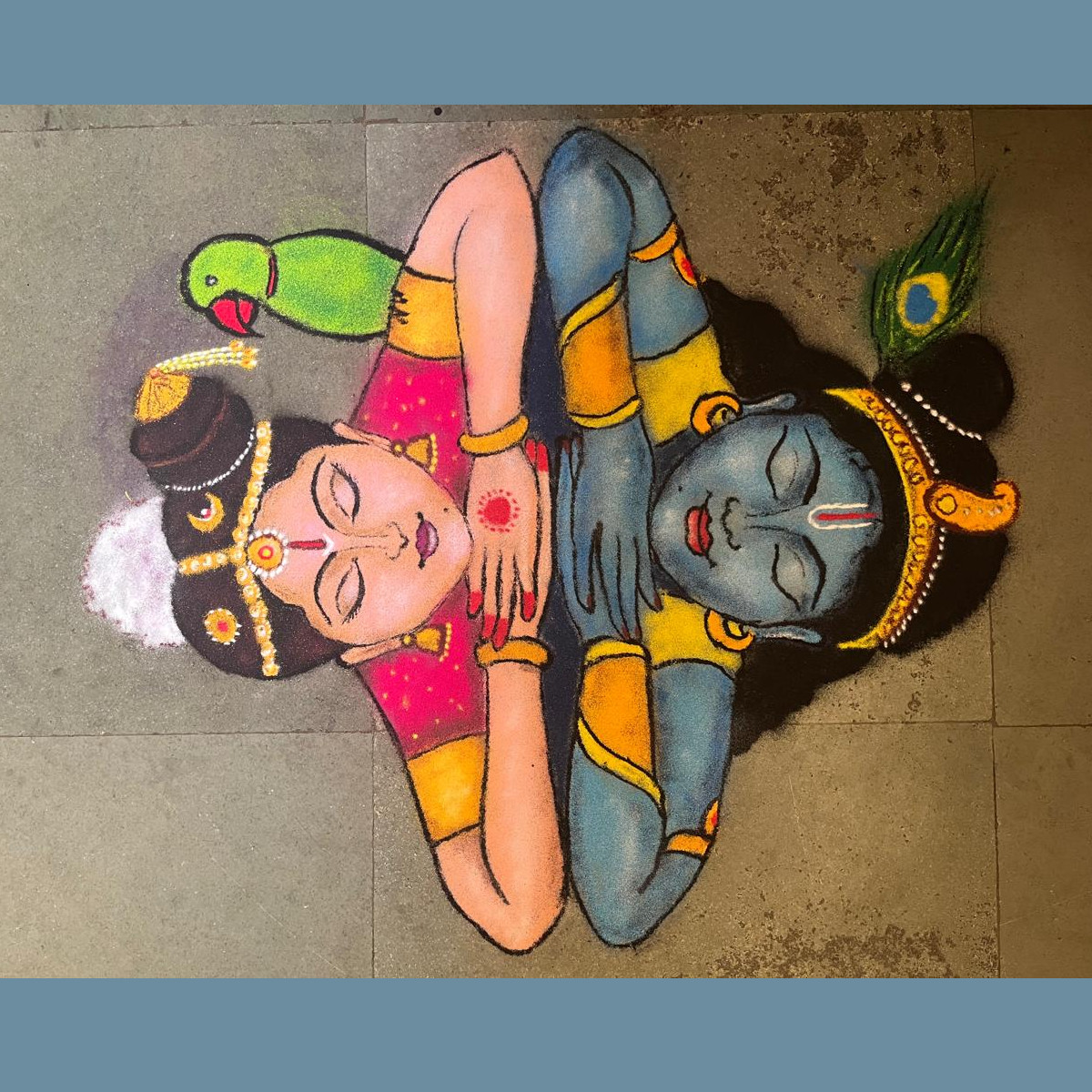
Photo Courtesy: This post’s photo is a freeform Rangoli of Andal and Krishna, drawn on her front-yard by Vijayabala from Chromepet, who is passionate towards art and rangoli.


