
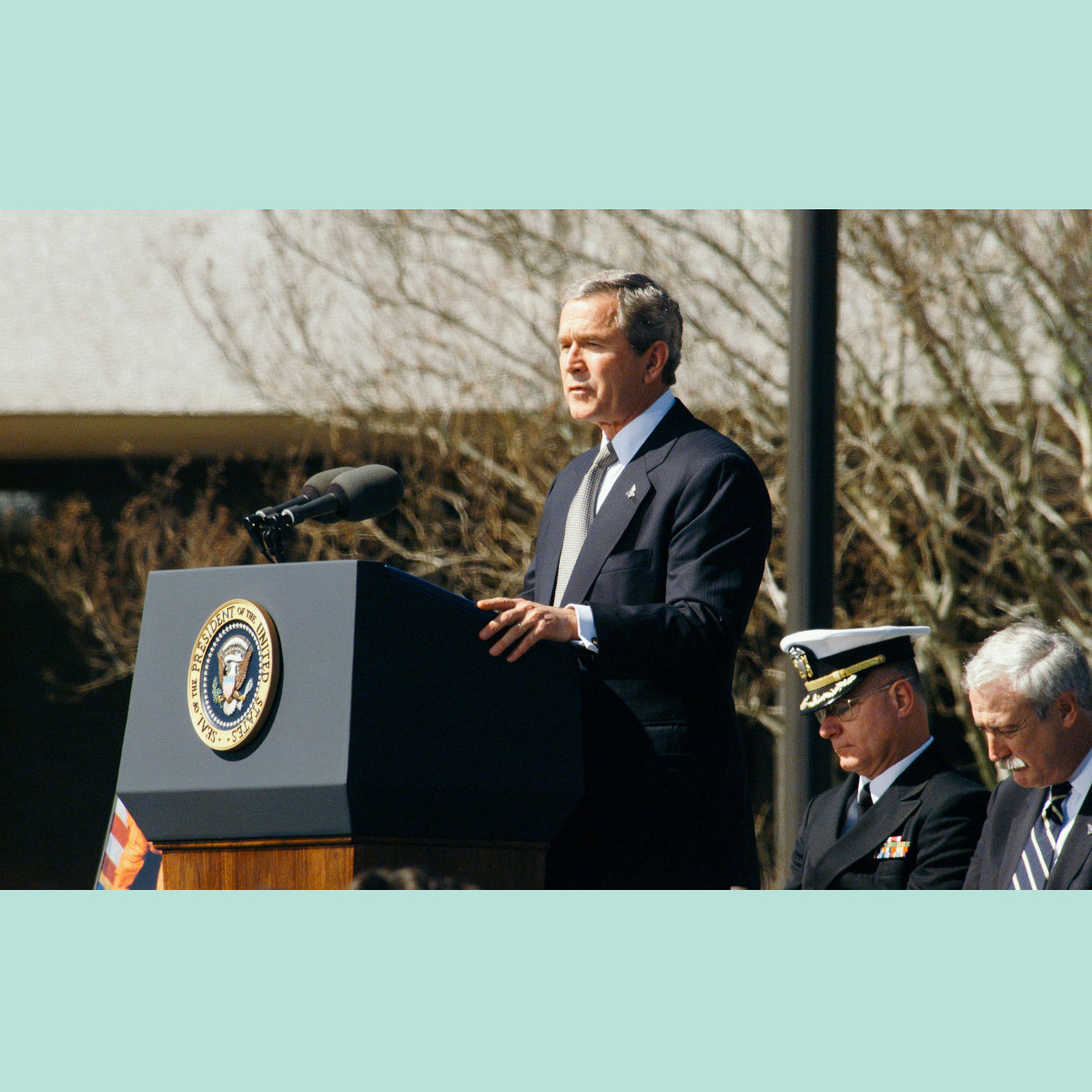


Ever heard of “Bushism”? George W. Bush, the 43rd President of the United States, often mixed up his words or had verbal slips that left people either scratching their heads or laughing out loud. But these quirky moments gave us a new term. Bushism, similar to Spoonerism, refers to unintended verbal slips as opposed to the standard linguistic concepts like homophones or metonymy, which are deliberate or systematic language use.
Serving from 2001 to 2009, Bush’s presidency was marked by major events like 9/11. Yet, alongside these serious matters, his unique way of speaking often stole the spotlight, with some unforgettable gaffes.
While folks joked about these linguistic errors, they also sparked interesting discussions about communication, leadership, and how politics is portrayed in the media.
Origins of Bushism
The concept of Bushism quickly gained traction early in his presidency. His tendency to misspeak, invent new words, or misuse existing ones became a hallmark of his public appearances. These often came from his attempts to simplify complex ideas, leading to humorous or confusing statements.
Bush himself often acknowledged these quirks with humor. For instance, he once quipped, “They misunderestimated me,” ( Bentonville, Arkansas, November 6, 2000) turning a gaffe into a self-referential joke. This blend of self-awareness and linguistic creativity is central to this unique concept.
Notable Examples
Bushisms are plentiful and varied, from simple word mix-ups to convoluted sentences that defy grammar. Here are a few famous examples:
- “I know the human being and fish can coexist peacefully.” (Saginaw, Michigan, September 29, 2000)— A statement meant to reassure environmentalists, but its odd phrasing made it a classic.
- “There’s an old saying in Tennessee—I know it’s in Texas, probably in Tennessee—that says, fool me once, shame on…shame on you. Fool me—you can’t get fooled again.” (Nashville, Tennessee, September 17, 2002) — Bush’s attempt to quote an old adage resulted in a memorable one.
- “Rarely is the question asked: Is our children learning?” (Florence, South Carolina, January 11, 2000) — Highlighting his concern for education, this statement ironically included a grammatical error.
- “We ought to make the pie higher.” (Columbia, South Carolina, February 15, 2000) — Bush advocated for economic growth, but the metaphorical “pie” and the idea of making it “higher” rather than “bigger” left many amused and perplexed.
- “I’m the decider, and I decide what is best.” — A tautological statement from a press conference that became a Bushism due to its redundancy.
These examples showcase the range of Bushisms, from simple slip-ups to more complex, baffling statements. They reflect Bush’s distinct communication style, which relied on plain language, sometimes at the cost of precision.
The Cultural Impact
Bushisms became a cultural phenomenon, inspiring books, websites, and even merchandise. The most famous compilation, George W. Bushisms: The Slate Book of Accidental Wit and Wisdom of Our 43rd President by Jacob Weisberg, cataloged many of his gaffes and became a bestseller. The term “Bushism” entered popular lexicon, describing any linguistic faux pas.
The media played a huge role in amplifying it, with late-night comedians and shows like “The Daily Show” frequently featuring his latest verbal missteps.
Bushism and Leadership
Bushism also opens up a deeper conversation about the relationship between language and leadership. Political leaders are often expected to communicate clearly and effectively, with a degree of eloquence. Bush’s linguistic struggles challenged these expectations, making people rethink the role of rhetoric in leadership.
Despite his frequent gaffes, Bush served two terms and won the support of millions. His supporters appreciated his straightforwardness, authenticity, and his plain way of speaking, even if it was occasionally muddled. In this way, Bushism can be seen as a pushback against the polished, scripted rhetoric typical of politics.
In the end, Bushism isn’t just a collection of verbal blunders; it’s a reminder of the power of words—whether well-chosen or not—and their lasting impact on how we remember a president and his era.
Have other leaders lent their names to new words?

