
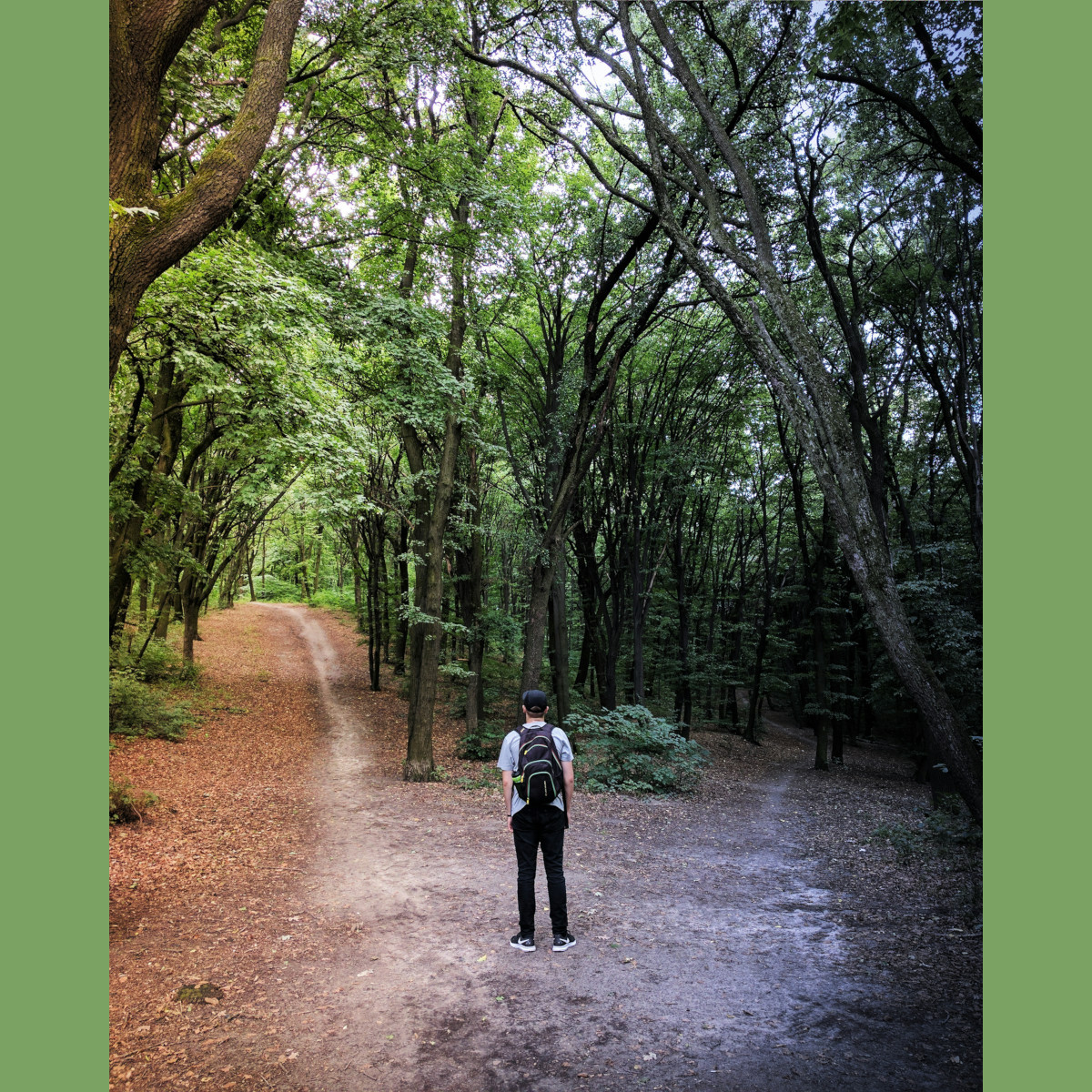


Have you ever wondered about the choices you made in life? Were they informed choices? Do you think what could have happened if you had taken the road not taken? I’m not referring to the famous Robert Frost poem “The Road Not Taken“, but the literal path you left unexplored in life. I’m definitely not talking about regrets over roads you knew about and still avoided, but the choices you never even considered because you simply didn’t know what lay ahead.
We all have made such choices which were not informed. Often, we convince ourselves we did the right thing with sayings like, “A known devil is better than an unknown angel.” Because the words resonate, they comfort us, reinforcing the idea that we made the “right” choice. But how wise is it to let a saying guide or judge our decisions?
Blind Choices
When I finished my 10th grade, I faced a choice about what to study next. My school in India offered two “science” streams: Maths-Physics-Chemistry-Biology or Maths-Physics-Chemistry-Computer Science. There were other schools with “commerce” streams, combining subjects like Maths, Commerce, Accountancy, Economics, or Statistics. I didn’t know enough about “commerce” to make an informed decision. Aside from learning how to calculate basic taxes, I hadn’t done anything related to the “commerce” stream till then. Humanities as a choice was rarely spoken of or offered in my environment then.
So, I went with a “science” stream, picking Computer Science. I was a good student, enjoyed Maths, Computer Science, and Biology, though I wasn’t exactly in love with science as a whole. But in my era, “good students” took science, especially biology. Faced with a choice between Biology and Computer Science, my logical mind leaned towards the latter, still retaining the “safe” choice of sciences. My parents had a “science” background as well, and so I never ever seriously considered anything else.
Informed Choices
Today, as I observe how career choices are approached in my son’s British Curriculum school, the contrast is stark. The students have multiple options, and they choose nine subjects in Grades 9 and 10. Five of these are compulsory—English Language, English Literature, Maths, and Double Science, making up the “safe territory.”
Beyond these core subjects, they choose four from a range of options–Arabic, Art & Design, Business Studies, Computer Science, Dance, Design & Technology (Graphic Design or Resistant Materials), Drama, Economics, Food Preparation & Nutrition, Further Maths, Geography, History, ICT (Information & Communication Technology), Media Studies, Modern Foreign Languages(French or Spanish or German), Mandarin Chinese, Music, Music Technology, Physical Education, Sport, Psychology, Textile Design, Travel & Tourism.
They also study foreign languages early, getting exposure to options like French, Spanish, and German, a term each, in Grades 4 and 5. By Grade 6, they settle on a language. They get either one or more terms of learning or “taster sessions” in various subjects by Grade 7; they’re well-informed when they finally choose for Grade 8; they can change subjects during the entire Grade 8; they freeze their choices before entering Grade 9.
In short, they’re spoilt for choices and they’re empowered to make informed choices.
Informed choices in Education
The differences between these two systems are immense. When the education system and schools allow for informed choices,
- they respect each child’s unique strengths and preferences.
- they encourage the students to pursue what they genuinely enjoy.
- a child’s interests shape their education, not societal expectations.
- they learn to research and weigh options, a crucial life skill.
I hope that the Indian education system has evolved to provide students with a broader set of options and better guidance to make informed choices. Today, more diverse academic streams are available, from liberal arts to vocational training, which is a promising shift. However, it’s essential that students are also given the tools, time, and encouragement to explore these options meaningfully before they commit.
Do Informed Choices matter?
Making informed choices is important because it empowers individuals to take control of their lives and make decisions that align with their values, goals, and personal strengths. They often shift your perspective in several powerful ways.
When you make an informed choice, you gain a clearer understanding of the available options. This awareness broadens your perspective, allowing you to consider pathways or opportunities you might not have thought of before.
With a well-informed decision, you’re more likely to feel confident and satisfied, reducing the urge to second-guess yourself. This confidence leads to a healthier, forward-focused mindset, helping you focus on the positives of your choice rather than the “what-ifs.”
An informed choice often comes from careful, independent thought, which helps you feel less swayed by others’ opinions or societal expectations. Over time, this creates a habit of prioritizing your own values and goals, making you more resilient to external pressures.
Making informed decisions means weighing different factors, assessing risks, and predicting potential outcomes. This process strengthens your analytical and problem-solving skills, enhancing your ability to navigate complex situations in all areas of life.
With each informed decision, you start to build trust in your own judgment and decision-making abilities. Over time, this leads to a stronger, more self-assured perspective, where you feel more confident in tackling new and challenging choices.
In today’s world of abundant choices, developing the skill to make informed decisions has never been more essential. Rather than simply thinking, “A known devil is better than an unknown angel,” let’s shift our mindset to: “Explore the devil-side of the unknown angel, weigh it against the known devil, and then decide.”
What blind choices or informed decisions have you made in life? What are you current thoughts about them? Share them in the comments!
Photo Courtesy: Photo by Vladislav Babienko on Unsplash